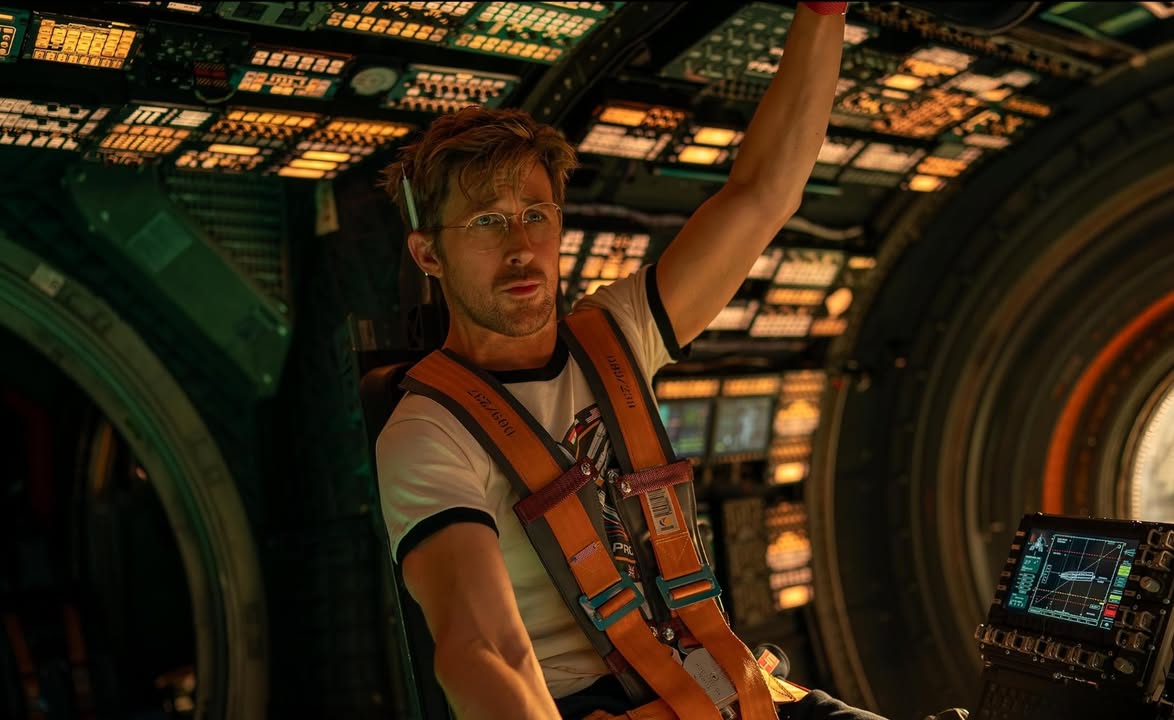
In act one, a man wakes alone on a spacecraft with no memory, no context, and no idea why he’s millions of miles from home. As fragments return, he realises he’s Ryland Grace, a former science teacher sent on a near-impossible mission to save a dying Earth from a cosmic threat consuming the sun. It’s a simple premise, but it pulls you in quickly. You’re learning with him, solving problems in real time, and it’s oddly gripping.
Directed by Phil Lord and Christopher Miller, with a script by Drew Goddard adapting Andy Weir, the film leans into intelligence without losing warmth. Ryan Gosling carries it with a performance that feels disarmingly human. He’s confused, occasionally panicked, but also quietly funny in that dry, self-aware way that keeps the film from drifting into cold abstraction.
And then, without much warning, the film opens up. Not with spectacle, but with something stranger. An encounter. An alien presence that doesn’t arrive with bombast, but with curiosity. The film treats it with a kind of awe, letting you sit in the uncertainty before revealing just enough. What follows is one of the most inventive relationships in recent sci-fi, built not on conflict, but communication. Or at least, the attempt at it. It’s clever, yes, but also unexpectedly moving.
Visually, it’s precise and tactile, helped by practical sets and restrained effects that keep everything grounded. The score threads emotion through the silence, never overplaying its hand.
What lingers is the optimism. Not just about survival, but about connection across the unknown. It’s big science fiction with a genuinely beating heart. You might come for the premise, but you stay for that sense of wonder.