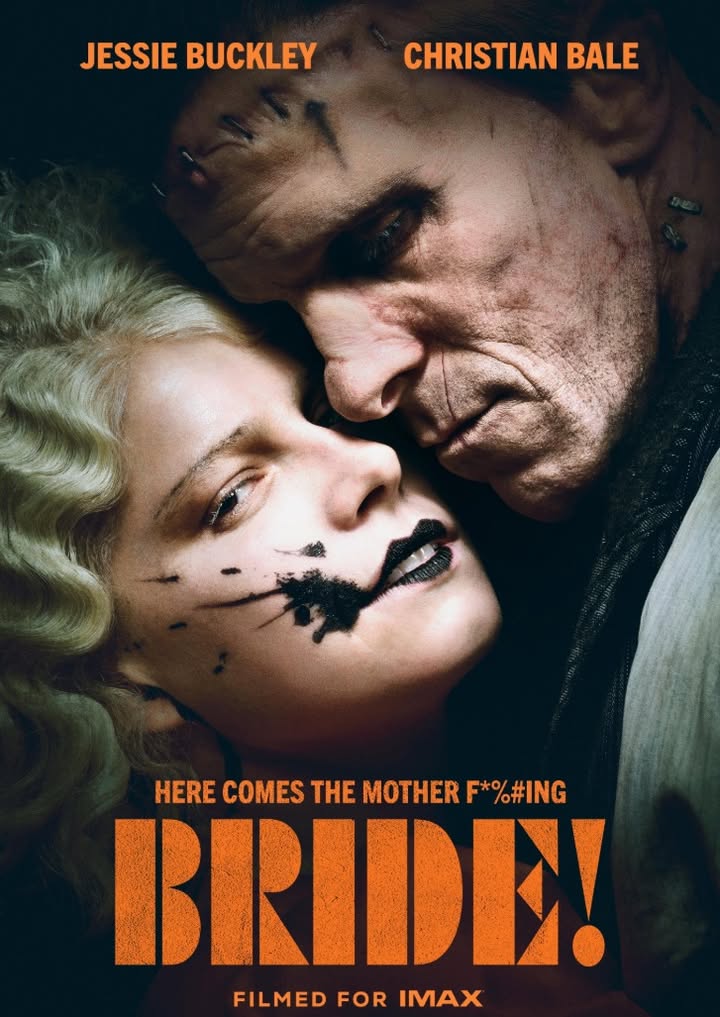
Mary Shelley narrates from beyond the grave, insisting the story everyone knows about Frankenstein’s monster was never the real tale. The real story, she says, belongs to the woman created for him. From there we land in 1930s Chicago, where Jesse Buckley plays a glamorous, permanently tipsy party girl who taunts the wrong crime boss and ends up dead at the bottom of a staircase. Her body is soon exhumed by Dr Ephronius, a brilliant scientist played by Annette Bening, after a lonely visitor arrives with a request. Christian Bale’s monster wants a companion.
What comes back to life is not quite the woman who died. The Bride wakes with fragments of Shelley’s spirit and almost none of her old memories, emerging instead as a volatile, rebellious force with a razor sharp grin and a total refusal to behave.
Gyllenhaal, following the controlled intimacy of The Lost Daughter, swings for something far bigger and stranger. The film gleefully stitches together genres the way Frankenstein assembled his creature. Gothic horror collides with gangster melodrama, and then a party suddenly erupts into a musical number. Even the monster has an unlikely idol in a flamboyant movie musical star played by Jake Gyllenhaal.
Buckley is sensational. Her Bride is anarchic, funny and fiercely self possessed, the engine powering the film’s chaos. Bale plays the monster with surprising tenderness, leaning into the character’s loneliness and awkward romantic longing rather than brute menace.
As the pair rampage through Chicago they become grotesque folk legends, a kind of monstrous Bonnie and Clyde. Meanwhile a determined detective, played by Peter Sarsgaard, closes in with help from his far sharper partner, played by Penélope Cruz.
It’s bold, messy and wildly ambitious, even if the story pinballs between ideas so fast that not everything sticks.